
Understanding UK Education Levels: A Complete Guide from Level 2 to Level 8
April 5, 2026 2026-04-05 19:27Understanding UK Education Levels: A Complete Guide from Level 2 to Level 8
The UK education system is globally respected for its structured progression and flexibility, allowing students from different backgrounds to enter higher education pathways. Whether a student has followed traditional schooling or is entering through vocational routes, the UK framework offers multiple entry points to achieve academic and career success.
This guide explains the different UK education levels, their equivalent qualifications, and the age groups typically associated with each stage.
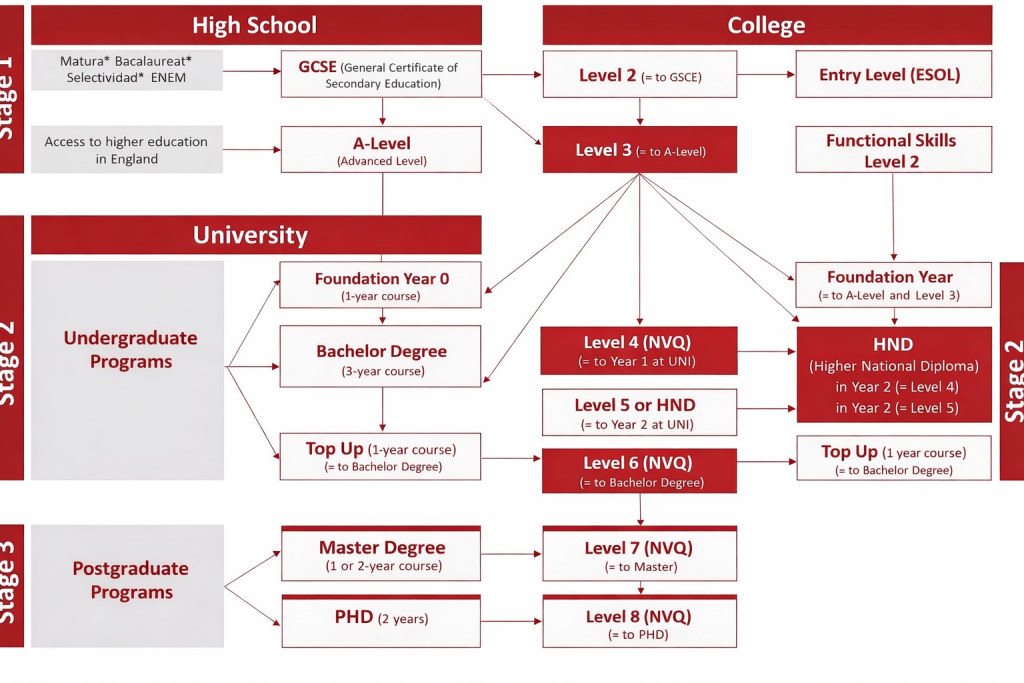
Overview of UK Education Levels
The UK education system is divided into levels that represent increasing complexity and depth of knowledge. These levels are part of the Regulated Qualifications Framework (RQF), which standardizes education across England and aligns with international qualifications.
Level 2 – Foundation Stage (Equivalent to O Levels / Grade 10)
- Typical Age Group: 14–16 years
- Examples: GCSEs, O Levels, Functional Skills Level 2
Level 2 is considered the foundational stage of secondary education. Students at this level develop basic academic knowledge and skills across subjects like Mathematics, English, and Science.
Level 2 is equivalent to O Levels or Grade 10, making it a crucial milestone for students preparing for further academic or vocational study. For students who may not have completed formal schooling, Level 2 provides an excellent re-entry point into education.
Level 3 – Advanced Stage (Equivalent to A Levels / Grade 12)
- Typical Age Group: 16–18 years
- Examples: A Levels, AS Levels, BTEC Level 3 Diplomas
Level 3 builds upon the foundation of Level 2 and prepares students for higher education or skilled employment. It is equivalent to A Levels or AS Levels, which are widely recognized for university entry.
Students at this level specialize in specific subjects or career-focused pathways such as Business, IT, Engineering, or Health and Social Care.
Level 3 qualifications are critical because they:
- Serve as the primary requirement for university admission
- Provide in-depth subject knowledge
- Open pathways to both academic and vocational careers
Level 4 – First Year of Undergraduate Study
- Typical Age Group: 18+ years
- Examples: Higher National Certificate (HNC), Level 4 Diplomas
Level 4 represents the first year of a bachelor’s degree. It introduces students to higher education learning styles, including research, critical thinking, and independent study.
Students who complete Level 4 gain:
- Fundamental knowledge in their chosen field
- Practical and theoretical understanding
- The ability to progress to Level 5
Level 5 – Second Year of Undergraduate Study
- Typical Age Group: 19+ years
- Examples: Higher National Diploma (HND), Level 5 Diplomas
Level 5 is equivalent to the second year of a bachelor’s degree. It builds on Level 4 knowledge and focuses on advanced concepts, practical application, and industry relevance.
At this stage, students:
- Develop specialized skills
- Gain deeper subject expertise
- Often engage in internships or work placements
Level 5 qualifications such as HNDs are highly valued by employers and can also lead directly to the final year of a bachelor’s degree.
Level 6 – Final Year of Bachelor’s Degree
- Typical Age Group: 20+ years
- Examples: Bachelor’s Degree (BA, BSc), Level 6 Diplomas
Level 6 represents the final year of a three-year bachelor’s degree in the UK. Students at this level demonstrate advanced knowledge, critical thinking, and independent research skills.
Key components include:
- Dissertation or final project
- Advanced subject specialization
- Preparation for employment or postgraduate study
Completion of Level 6 awards a full bachelor’s degree, which is recognized worldwide.
Understanding the Full Pathway (Level 4, 5, and 6)
Levels 4, 5, and 6 together are equivalent to a complete three-year bachelor’s degree in the UK education system. This structured progression allows students to:
- Enter at different stages depending on their qualifications
- Exit with recognized certifications at each level
- Continue seamlessly toward higher education
Why UK Education Levels Matter
The UK education framework is designed to be:
- Flexible: Students can enter at multiple levels
- Inclusive: Suitable for both academic and vocational learners
- Globally Recognized: Accepted by universities and employers worldwide
For students without traditional schooling, vocational qualifications at Level 2 and Level 3 provide a powerful pathway to university entry.
Alternative Pathways to Success
One of the biggest advantages of the UK system is that it does not limit students based on their past. Even if someone has not completed formal schooling, they can:
- Start at Level 2 or Level 3
- Progress to Level 4 and beyond
- Eventually enter university and complete a degree
This creates opportunities for lifelong learning and career transformation.
Understanding UK education levels is essential for students planning their academic journey. From Level 2 (equivalent to O Levels) to Level 6 (final year of a bachelor’s degree), each stage plays a vital role in building knowledge and skills.
At Northernhamshire Ilexford Tessor (NIT) College of Technology London, we offer UK levels of education in affiliation with recognized awarding bodies, ensuring that students receive globally accepted qualifications and industry-relevant learning.
We specialize in helping students—especially those without formal schooling—progress through vocational qualifications and successfully enter university pathways.
The UK education system proves that no matter where you start, there is always a structured path to success.